


Heat Recovery Systems: Turning Wasted Heat Into Lower Fuel Bills
Most industrial steam plants pay for the same energy twice. Gas is burned to raise steam, the steam does its job, and then a surprising share of that heat walks straight out of the building — up the stack as hot flue gas, off a vent as flash steam, or down the drain as hot condensate and boiler blowdown. None of it shows up in the product. All of it shows up on the gas bill.
Heat recovery systems exist to close that gap. Rather than letting hot streams leave the plant, they capture the energy still in them and put it back to work — usually by preheating boiler feedwater, but often by feeding a lower-pressure load elsewhere on site. The result is less fuel burned for the same output, and a payback that, on the right project, lands inside a year.
This article walks through where that recoverable heat hides, the four recovery streams worth chasing, and how to work out what they’re actually worth on your plant.
What a heat recovery system actually does
At its simplest, a heat recovery system moves energy from a stream you were about to throw away into a stream you’d otherwise have to heat from scratch. A boiler economiser, for example, uses hot flue gas on its way to the stack to warm the incoming feedwater. The feedwater arrives at the boiler hotter, so less gas is needed to bring it to steaming temperature.
The principle is the same across every form of waste heat recovery: find a hot stream heading for atmosphere or drain, find a cold stream that needs heating, and put a heat exchanger between them. The engineering is in matching the two — the temperatures, the flows, the timing — so the recovered energy is genuinely useful rather than just shuffled around.
Where the recoverable heat is hiding
In a typical steam system, the losses cluster in four places. The diagram below maps them onto the steam loop, with the recovery equipment (green) sitting where each stream would otherwise be vented or sent to drain (red).
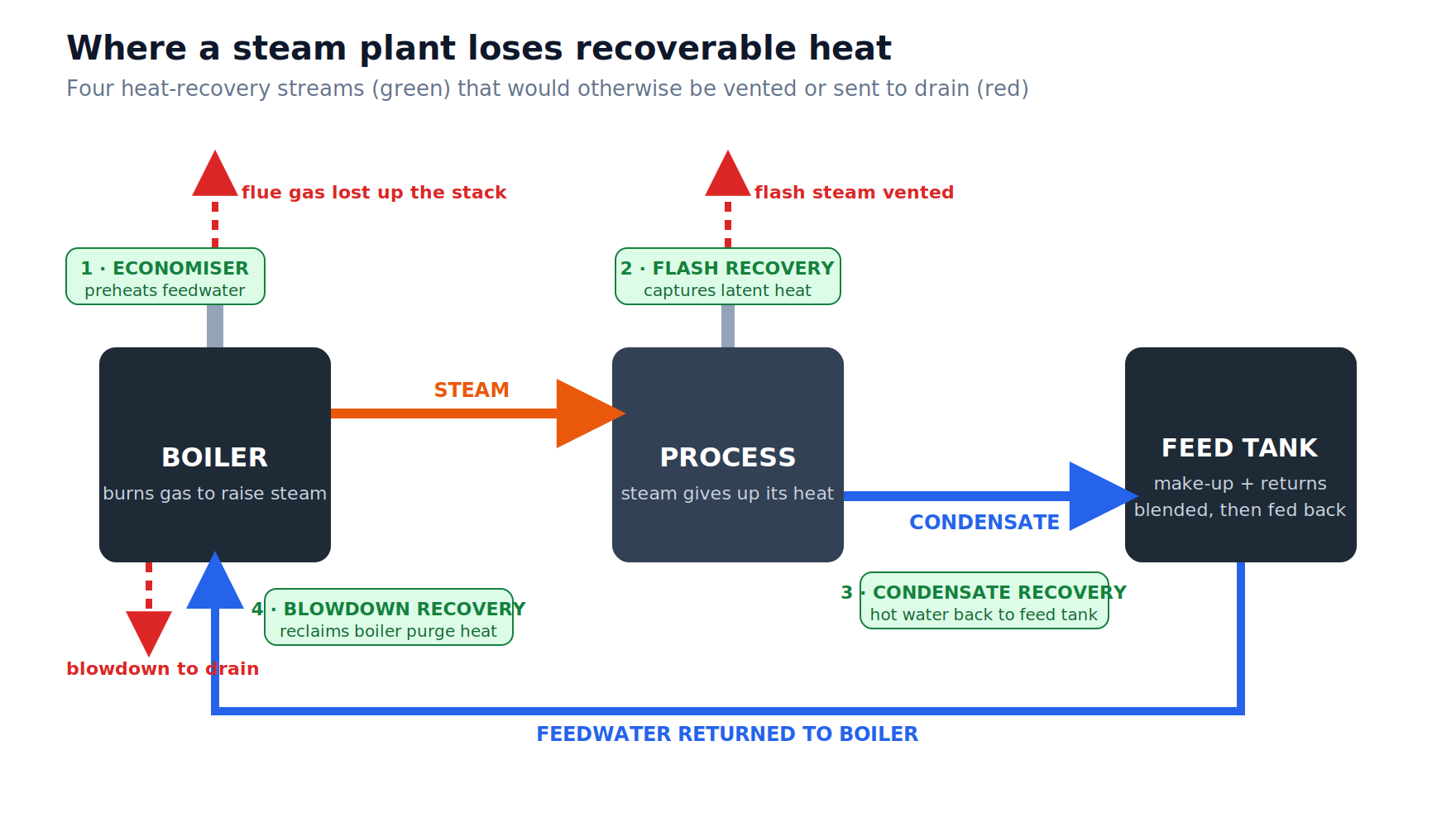
Where a steam plant loses recoverable heat — and the recovery systems that capture each stream.
The pattern is worth noticing: every loss is a stream that is still hot when it leaves. Heat that has already cost you gas to create is being discarded while it’s full of energy. That’s exactly the heat an energy recovery system is built to reclaim.
The four recovery streams worth chasing
1. Flue gas — an economiser. The exhaust leaving a boiler is hot, and a large boiler sends a lot of it up the stack. An economiser is a gas-to-water heat exchanger in the flue that transfers that heat into the feedwater. As a rule of thumb, every 6 °C rise in feedwater temperature trims boiler fuel by roughly 1%, so the gains add up quickly on a plant running around the clock.
2. Flash steam — a flash recovery vessel. When hot condensate drops to a lower pressure, a fraction of it instantly re-boils into flash steam. Vented to atmosphere, that’s the visible white plume drifting off feed tanks — and it’s live energy leaving the building. A flash recovery vessel captures it and routes it to a low-pressure load or back through a heat exchanger to preheat feedwater.
3. Condensate — a condensate recovery system. Hot condensate carries a meaningful share of the original steam’s energy, plus already-treated water. Returning it to the feed tank instead of dumping it cuts fuel, make-up water and chemical dosing in one move. We covered this in detail in our piece on how condensate recovery improves steam efficiency — it’s often the first stream worth recovering because the water is already clean and hot.
4. Blowdown — a blowdown heat recovery unit. Boilers are periodically purged to control dissolved solids, and that blowdown leaves at boiler temperature. A flash vessel and heat exchanger on the blowdown line reclaims most of that heat to preheat make-up water, rather than sending it scalding to the drain.
A well-designed plant usually combines several of these. Packaged hot-water heat exchangers, flash steam recovery skids and condensate pump sets are the building blocks — exactly the kind of standard and bespoke package solutions that get bolted together into a recovery scheme to suit the site.
What the numbers look like
These projects aren’t theoretical. On a recent project at Teys’ Wagga Wagga rendering plant, Energy Specialties designed a bespoke flash steam recovery skid that preheats 16,000 L/hr of boiler feedwater from 98 °C to 125 °C, paired with a vapour condenser to capture the residual waste heat that was previously vented. Together the two systems recover around 3.3 GJ per hour that used to be lost to atmosphere — cutting the thermal energy used per head of cattle processed by more than 30%. The full detail is in the flash steam recovery case study.
The pattern repeats across sites. Clients have reported outcomes such as a 40% reduction in gas usage after a system upgrade, with a return on investment inside 12 months on most projects. The exact figure depends on your fuel cost, your run hours and how much heat you’re currently throwing away — which is the one thing worth measuring before anything else.
How to find what it’s worth on your plant
The temptation is to jump to equipment. The better starting point is measurement. A few visible signs you’re leaving money on the table: vapour plumes off vents and feed tanks, condensate running to drain, high make-up water consumption, and hot drains around the boiler house.
Turning those signs into numbers is the job of a system appraisal, backed by proper steam and water metering. Metering establishes how much heat each stream is carrying today and what it would be worth to recover — so the recovery scheme is sized to the real opportunity rather than a guess. From there, a consultancy and system design review sets out which streams to recover, in what order, and what each will return.
Where to start
Heat recovery is rarely a single piece of kit — it’s a set of streams, each worth a different amount, that together can take a real bite out of a plant’s gas bill. The economiser, the flash vessel, the condensate return and the blowdown line all do the same job: stop paying for heat you’ve already generated and then discarded.
If your plant is venting energy it could be reusing, an appraisal is the quickest way to find out what that’s costing — and what it would take to recover it. Once the scope is set, it can be designed, packaged and installed as a single turnkey project. Get in touch with Energy Specialties to scope what heat recovery could be worth on your site.