


Optimum Steam Distribution: Getting Dry Steam To The Point Of Use At The Right Pressure
A boiler can be perfectly tuned and a process perfectly specified, and the plant can still run badly — because the two are joined by a distribution system that loses pressure, carries wet steam and hammers itself apart. Steam distribution is the plumbing between where steam is made and where it does work, and it is where a lot of avoidable energy and reliability problems quietly live.
Getting it right isn't exotic. Optimum steam distribution comes down to delivering steam that is dry, at the correct pressure, in the right quantity, without waterhammer, and with the smallest practical heat loss along the way. Here's what that takes.
Dry steam is the whole game
The value of steam is its latent heat, and you only get the full latent heat from dry saturated steam. Wet steam — steam carrying entrained water droplets — is the most common distribution problem and the most expensive, because it undermines everything downstream at once.
Wet steam carries less energy per kilogram, so processes take longer and the plant burns more fuel to keep up. The water droplets erode valve seats and pipe bends. Worst of all, a slug of water travelling at steam velocity is the raw material for waterhammer, which can crack fittings and injure people.
Dryness starts with the boiler but is won or lost in the distribution system. Steam mains should run with a slight fall in the direction of flow, be fitted with separators to strip out entrained moisture ahead of critical equipment, and be drained at regular intervals so condensate never has a chance to accumulate. Specifying the separators, strainers and trap sets that keep steam dry is core steam, condensate and water valving work.
Size the mains for pressure, velocity and the future
Pipe sizing is a genuine trade-off, and both directions cost money.
Undersize the main and steam velocity climbs. High velocity means high pressure drop, noise, erosion and a greater tendency to carry water along with the flow. Oversize it and you've spent capital on pipe and — more importantly — created a larger surface area radiating heat and holding more condensate at every start-up.
The usual targets are a steam velocity in the region of 25–40 m/s for saturated mains and a pressure drop held to a small fraction of the working pressure across the distribution run. Getting there means working from a real load estimate, not a guess, and allowing sensible headroom for future expansion without gross oversizing. That balance is exactly what steam piping design as part of full system design is meant to resolve.
Drain the mains properly — every drip leg counts
Even a well-insulated main loses some heat and forms condensate, especially at start-up when the cold pipe is condensing steam rapidly. That condensate has to be removed continuously, or it collects into slugs.
The mechanism is the humble drip leg — a pocket at the bottom of the main, fitted with a steam trap, that catches condensate and lets it drain while live steam carries on. Drip legs belong at every low point, ahead of every rise, before every control valve and at regular intervals along horizontal runs (a spacing of the order of 30–50 metres is a common guide). Skip them, undersize them, or fit the wrong trap, and condensate accumulates until the next surge of steam picks it up — the classic recipe for waterhammer.
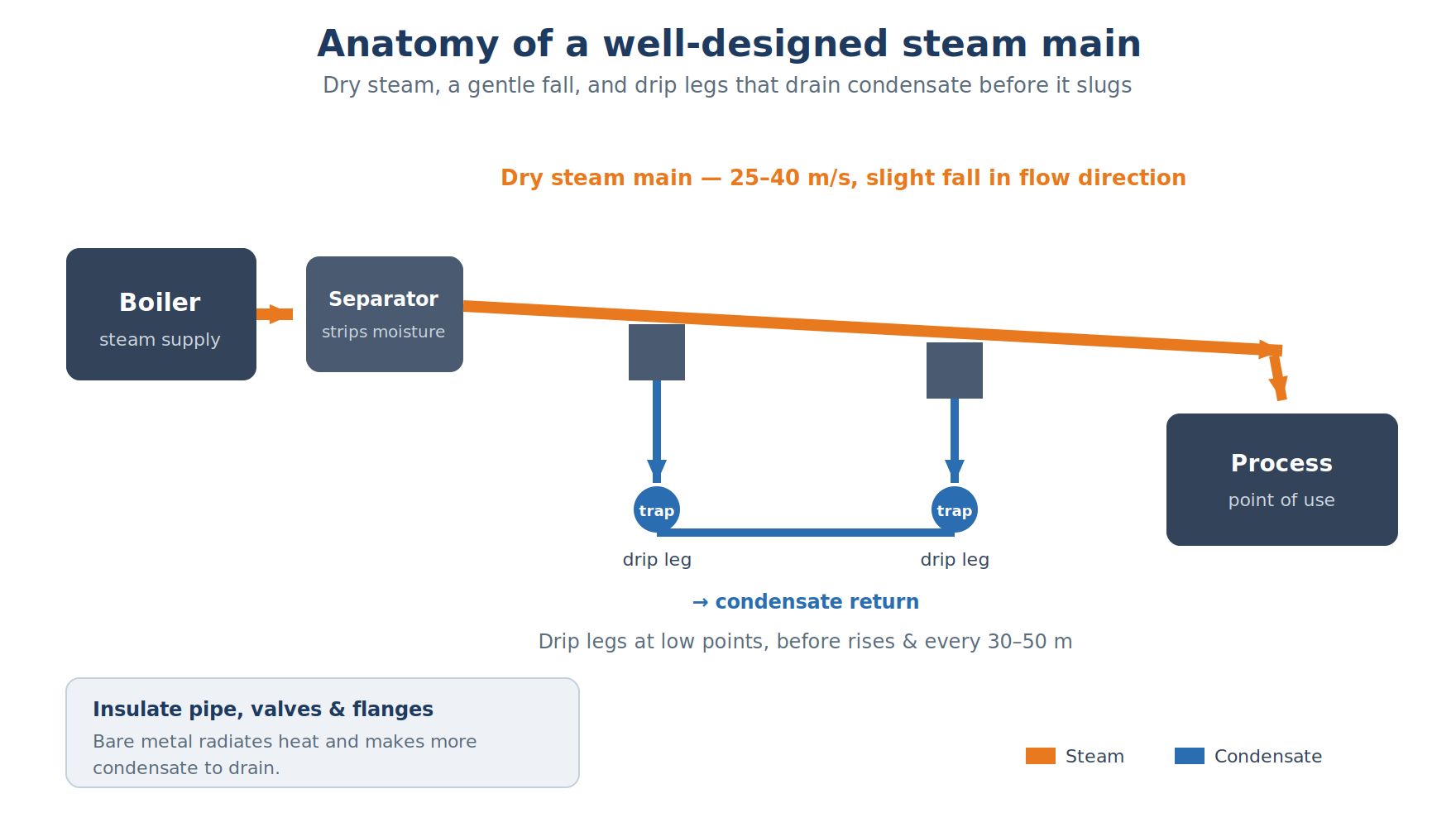
A well-designed steam main: dried at source, laid to a slight fall, and drained by drip legs and traps at low points.
Distribute high, use lower
It is often best to distribute steam at a higher pressure than the process needs and reduce it close to the point of use. Higher-pressure steam is denser, so it needs smaller-bore (and therefore cheaper, lower-loss) mains for the same energy delivery, and it stores usefully in the system to handle sudden load swings.
The pressure is then dropped locally through a pressure-reducing station, which also gives cleaner, more stable control at the equipment. The choice of distribution pressure is a design decision that ripples through pipe sizing, insulation and control, so it belongs in the system design stage rather than being left to whatever the boiler happens to be set at.
Insulate — the cheapest energy you'll ever save
Bare steam pipe is a continuous radiator. Every exposed valve, flange and metre of pipe sheds heat that the boiler has to replace, and generates yet more condensate that the drainage system then has to handle.
Insulation is unglamorous and it pays back fast. Insulating flanges and valves — often left bare for “access” — matters more than people expect, because a single uninsulated valve body can lose as much heat as several metres of pipe. Insulation is not a place to economise on a live steam system.
You can't optimise what you don't measure
Distribution problems hide well. Wet steam, a slowly failing trap population and creeping pressure loss all degrade performance without ever tripping an alarm. The only way to see them is to measure — steam flow to each area, pressures across the network, and condensate returned versus water made up.
Metering turns a distribution network from a black box into something you can manage, and it's what makes an efficiency case defensible to a finance team. That visibility is the job of steam and water metering, and it's usually the first instrument we recommend before proposing any change to industrial steam systems.
A quick sizing sanity check
For a rough pipe-sizing sanity check, the steam velocity in a main is:
v = (ṁ × v_g) ÷ A
where ṁ is the steam mass flow (kg/s), v_g is the specific volume of steam at the working pressure (m³/kg), and A is the pipe's internal cross-sectional area (m²). As pressure rises, v_g falls, so the same mass of steam needs less pipe area — the arithmetic behind “distribute high, use low”. Treat this as a scoping check; detailed design accounts for pressure drop, fittings and future load.
Bringing it together
Optimum steam distribution is the sum of unglamorous details done consistently: dry steam, correctly sized and gently falling mains, drip legs and traps that actually work, sensible distribution pressure, thorough insulation, and enough metering to prove it. Get them right and the same boiler delivers more useful heat, more reliably, on less fuel — the foundation that made recovery projects like Teys Wagga possible in the first place.
Whether your network needs a design review, a valving upgrade or a full rebuild delivered under turnkey installation and project management, it's worth starting from the plumbing. Talk to us about a distribution review.