


Steam Metering: Why You Can’t Save What You Can’t Measure
Steam metering is the practice of measuring how much steam a plant makes and where it goes, using a steam flow meter to report the mass of steam — in kilograms or tonnes per hour — passing key points in the system. It turns a single gas bill into a breakdown you can act on: which line uses what, where steam is being wasted, and whether a fix actually worked.
Most plants know their total gas spend to the cent but can’t say what any individual process costs to run. That gap is exactly what metering closes.
What does a steam flow meter measure?
A steam flow meter measures the flow of steam past a point in the pipe. Because steam is a compressible vapour, an accurate result isn’t just velocity — the meter, or its flow computer, also needs the steam’s pressure and temperature to convert that flow into a true mass flow in kg/hr. That mass figure is the one that matters, because it maps directly to energy, and therefore to fuel and cost. Meter the steam into a department and you know, in real numbers, what that department costs to run. It’s the same discipline Energy Specialties applies with its steam and water metering packages.
Why do so many plants get steam metering wrong?
The most common mistake is not metering at all — running the whole site off the boiler’s gas meter and a rough guess of who uses what. The rest tend to be these:
- One meter, no sub-metering. You learn total consumption but still can’t see where it goes.
- Ignoring compressibility. A meter that reads volume without pressure and temperature compensation drifts as conditions change, so the numbers wander.
- Wet steam at the meter. Carryover and water droplets upset most flow meters; steam should be dry and well-separated where it’s measured.
- Poor placement or sizing. Too little straight pipe upstream and downstream, or a meter sized for the wrong flow range, and the reading can’t be trusted.
- Metering, then never looking. Data gets logged but never turned into a decision.
Get these wrong and the meter becomes a number nobody trusts — which is worse than no meter, because it undermines confidence in the whole exercise.
Where should you put a steam flow meter?
The arrangement that works is a master meter plus sub-meters.
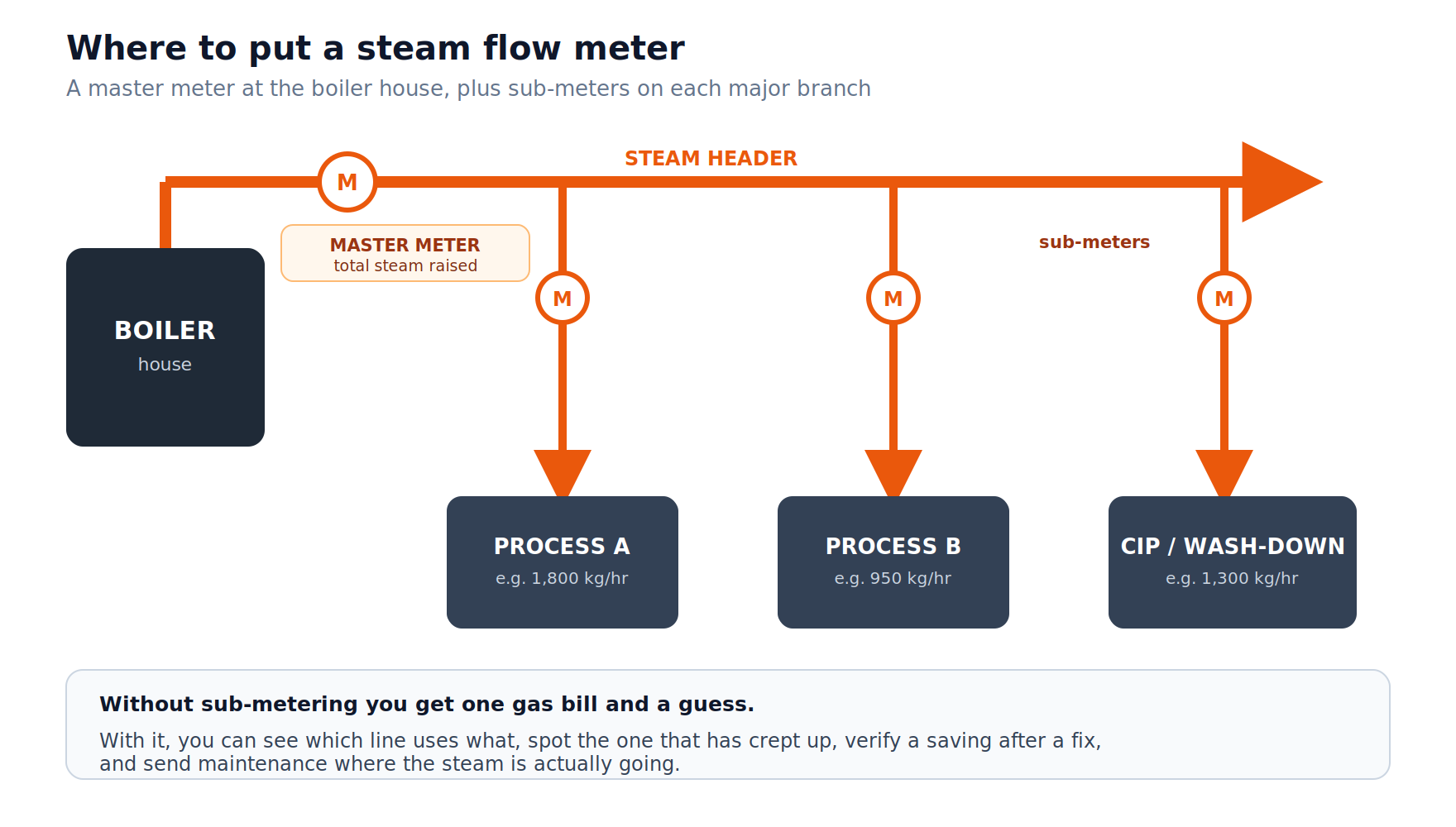
Where to fit a steam flow meter: a master meter at the boiler house, plus sub-meters on each major branch.
A master steam flow meter at the boiler house tells you total steam raised — useful for a plant-wide energy balance and for reconciling against gas consumption. Sub-meters on each major branch — a process line, a department, CIP and wash-down — tell you who actually uses it. That’s where the value sits: the moment you can see steam by area, you can compare it, rank it and target it.
What steam metering lets you actually do
Once steam is measured, four things become possible:
- Allocate cost fairly. Charge steam back to departments or products by real usage rather than floor area or headcount — which changes behaviour on its own.
- Find the losses. A branch drawing more than its output warrants flags leaks, failed steam traps, or a process running longer or hotter than it needs to.
- Verify savings. After an upgrade — returning condensate, better insulation, or a heat-recovery scheme — metering is how you prove the saving is real rather than assumed.
- Prioritise maintenance. Send effort to the lines actually consuming steam, not the ones that squeak loudest.
This measure-first discipline is what underpins the results plants see — outcomes such as a 40% cut in gas usage at one meat processor, and a return on investment inside 12 months on most projects at another. You can’t target, or bank, what you haven’t measured.
How to choose a steam flow meter
There’s no single best meter; the right one depends on the line. The points that matter:
- Meter type. Vortex, orifice-plate / differential-pressure and other technologies each suit different pipe sizes, flow ranges and turndown.
- Turndown. Steam demand swings hour to hour, so the meter has to stay accurate across the range, not just at the design point.
- Pressure and temperature compensation. Essential for a true mass reading on steam.
- Placement and sizing. Dry steam, the correct straight-run lengths, and a meter matched to the actual flow.
Getting these right is a design question as much as a purchasing one, which is why it’s worth specifying metering as part of a proper system review.
Start by measuring
Steam metering isn’t the saving itself — it’s the instrument panel that shows where the savings are and confirms them once you’ve made them. A plant that meters can manage; a plant that doesn’t is flying blind.
Energy Specialties supplies steam and water metering that is economic, robust, accurate and easy to integrate, and can specify, install and commission it as part of a system appraisal or a turnkey project. Get in touch to work out where a meter would pay for itself first.
Frequently asked questions
What is steam metering?
Steam metering is measuring how much steam flows through a plant so energy use can be quantified by area, line or asset. It usually pairs a master steam flow meter at the boiler house with sub-meters on major branches, reported in kg/hr or t/hr.
What does a steam flow meter measure?
It measures the flow of steam past a point in the pipe. Because steam is compressible, an accurate result needs pressure and temperature compensation to convert the reading into a true mass flow in kg/hr, which maps directly to energy and cost.
Where should a steam flow meter be installed?
On dry, well-separated steam, in a straight run of pipe with the manufacturer's specified clearance upstream and downstream, and sized for the real flow range. A master meter at the boiler house plus sub-meters on each major branch gives the most useful picture.
Which type of steam flow meter is best?
There's no universal best. Vortex, orifice-plate / differential-pressure and other types each suit different pipe sizes, flow ranges and turndown. The right choice depends on line size, the range of flows you need to capture, and the accuracy required.
Is steam metering accurate enough to allocate cost?
Yes. With correct sizing, dry steam, adequate straight runs and pressure and temperature compensation, modern steam flow meters are accurate enough to allocate cost between departments and to verify savings after an upgrade.