


Steam Trap Systems: How Failed Traps Quietly Waste Fuel
A steam trap system is the network of steam traps that automatically drains condensate from a steam plant while holding live steam back. When traps fail — and a share of them always do — they either blow live steam straight to waste or let condensate flood back into the plant. Because a failed trap is usually invisible, finding and fixing them is one of the cheapest energy savings a site can make.
Most plants have dozens or hundreds of traps and no idea how many are working. This article explains what the traps do, how they fail, how to tell, and why a regular survey pays for itself.
What is a steam trap, and what does it do?
A steam trap is an automatic valve fitted to a steam line or a piece of steam-heated equipment. Its job is simple to state: let condensate and air out, while keeping live steam in.
Steam does its work by condensing and giving up its latent heat. The water left behind — condensate — has to be removed the moment it forms, or it chokes heat transfer, drags down equipment performance and sets up waterhammer. The trap handles that automatically: it opens to discharge condensate, then closes again to stop steam escaping. Multiply that across a whole site and you have the steam trap system — the quiet network that keeps the condensate moving and the steam where it belongs. Traps sit within the broader family of steam, condensate and water valving.
What are the main types of steam trap?
There are three families, each suited to different duties:
- Mechanical traps (float and thermostatic, inverted bucket) respond to condensate level or density. They discharge continuously and suit process heat transfer with changing loads.
- Thermostatic traps (balanced-pressure, bimetallic) respond to temperature. They’re compact and well suited to distribution drip points and air venting.
- Thermodynamic traps (disc type) respond to the difference in velocity between flashing condensate and steam. They’re robust and tolerant of high pressure, common on steam mains.
Matching the trap type and size to the duty is what separates one that lasts from one that fails early — a design decision, not a default.
How do steam traps fail — and what does it cost?
Traps are wear items, so failures are a question of when, not if. There are two modes, and both are expensive.
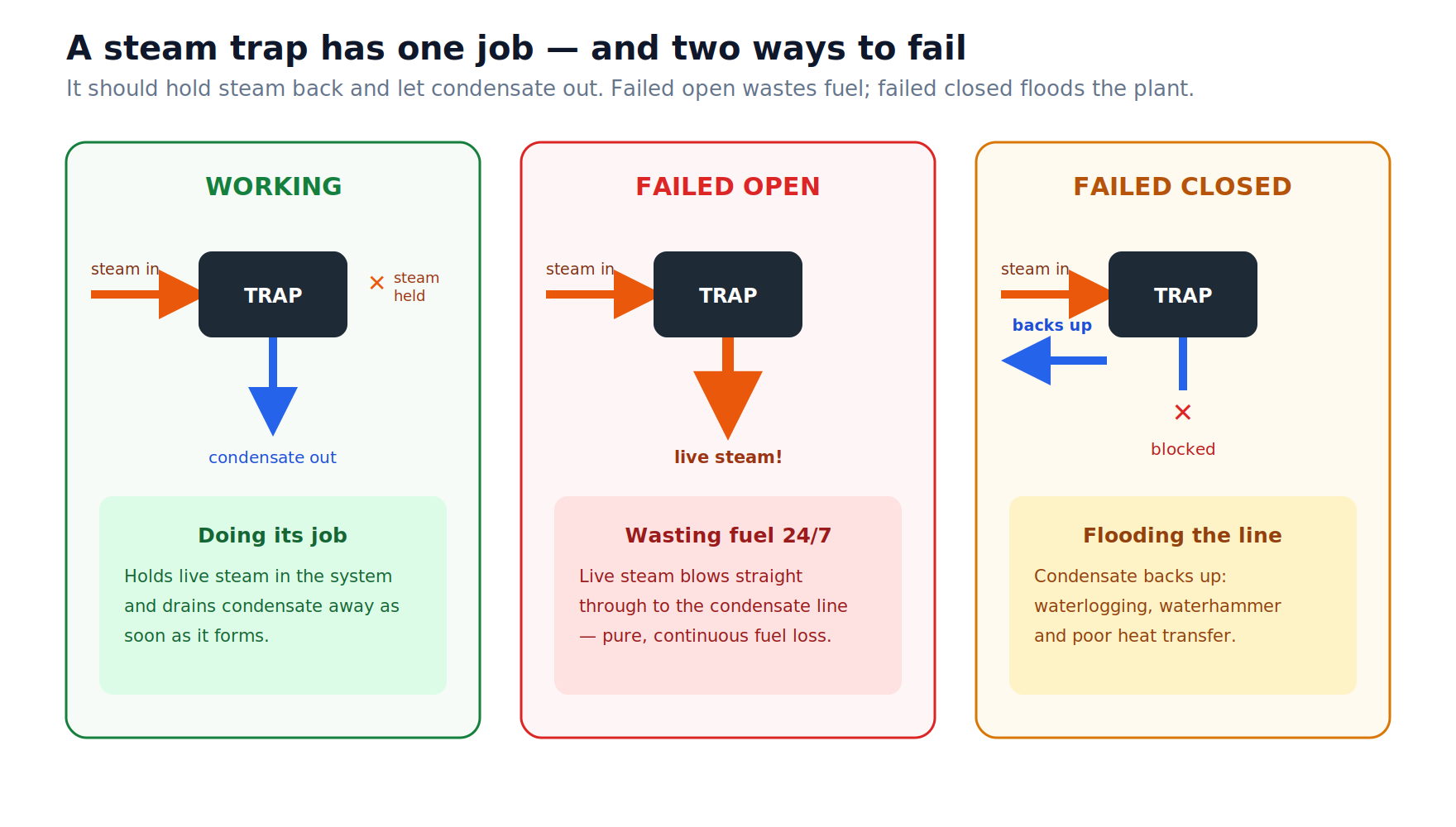
A steam trap working, failed open and failed closed: failed open wastes live steam continuously; failed closed floods the line with condensate.
Failed open is the costly-but-invisible one. The trap can no longer close, so live steam blows straight through to the condensate line, 24 hours a day. That’s pure fuel loss — you paid to raise that steam and it never did any work. Worse, it makes no noise and nothing stops working, so it can leak for years unnoticed.
Failed closed is the disruptive one. The trap can’t open, so condensate backs up into the equipment. That waterlogs the heat transfer surface (cutting output and product quality), corrodes the system, and causes waterhammer — the banging that cracks fittings and is a genuine safety hazard.
Because failures accumulate, an unmanaged system drifts steadily worse. As an industry rule of thumb, in a plant with no trap-management program, on the order of 20% of traps can be failed at any given time — most of them failed open and bleeding steam quietly.
How do you know if a steam trap has failed?
You usually can’t tell by looking, which is exactly why failures go unnoticed. Traps are tested a few ways:
- Temperature — a trap much hotter or colder than expected for its duty is a clue.
- Ultrasonic — listening to the trap shows whether it’s cycling correctly, blowing through, or dead.
- Sight glasses — where fitted, you can watch whether the trap is passing steam.
The reliable answer is a steam trap survey: every trap located, tagged, tested and its condition recorded, with the failed-open losses costed. It converts an invisible problem into a list you can act on.
Why a steam trap survey pays for itself
A survey turns a hidden loss into a ranked, costed set of repairs — worst offenders first. Because failed-open traps leak continuously, fixing the worst few often recovers the cost of the whole survey quickly. Done once, it’s a useful snapshot; done annually — traps keep failing — it becomes a management program that holds the saving in place. Metering the steam alongside it confirms the gains in hard numbers.
Designing and maintaining a reliable steam trap system
A steam trap system stays efficient when a few things are right: the correct trap type is fitted for each duty; traps are properly sized (oversized traps wear and waste, undersized traps waterlog); they’re installed where they can actually be reached and tested; and testing and replacement are scheduled rather than run-to-failure.
Energy Specialties supplies the traps and valving, and can survey an existing system through a consultancy and system design review, specify the right traps, and deliver the work — with condensate recovery packages where they stack up — as a single turnkey project. Get in touch to find out how many of your traps are quietly costing you money.
Frequently asked questions
What is a steam trap system?
It's the network of steam traps across a plant that automatically drains condensate from steam lines and equipment while holding live steam back. A single site typically has dozens or hundreds of traps working together.
What are the signs of a failed steam trap?
A failed-open trap continuously passes live steam to the condensate line, often with no obvious symptom, while a failed-closed trap causes condensate to back up, giving poor heating, waterhammer and reduced output. Most failures are confirmed by temperature or ultrasonic testing.
How often should steam traps be tested?
At least annually. Traps are wear items and fail steadily over time, so a yearly survey and repair cycle keeps the failure rate — and the wasted steam — under control.
How much energy does a failed steam trap waste?
A trap that has failed open leaks live steam continuously, so the loss runs 24 hours a day. In plants with no trap-management program, around 20% of traps can be failed at once (an industry benchmark), which adds up to a significant fuel cost.
What are the main types of steam trap?
The three main families are mechanical (float and thermostatic, inverted bucket), thermostatic (balanced-pressure, bimetallic) and thermodynamic (disc). Each suits different duties, and matching the type to the application is key to reliability.