


Industrial Compressed Air Systems: Cutting the Cost of the “Fourth Utility”
An industrial compressed air system is the network of compressors, storage, air treatment and pipework that supplies compressed air across a plant. It is often the most expensive utility per unit of useful energy, because most of the electricity a compressor draws ends up as heat rather than air — so ordinary inefficiencies like leaks and over-pressure carry an outsized cost.
Compressed air is so convenient and so safe at the point of use that it’s everywhere in industry — which is exactly why its running cost tends to go unquestioned. This article covers what the system is, why it’s so costly, where the energy leaks away, and the cheapest ways to claw it back.
What is an industrial compressed air system?
An industrial compressed air system has a handful of core parts: one or more compressors that generate the air, a receiver that stores it and steadies the supply, dryers and filters that treat it, drains that remove condensate, the distribution pipework that carries it around the plant, and the points of use at the end. Air is generated centrally and piped to wherever it’s needed.
It’s often called the “fourth utility”, alongside electricity, gas and water — but unlike the other three, most plants have no idea what theirs actually costs to run, because it isn’t separately measured.
Why is compressed air so expensive?
Two things make compressed air costly. First, compressing air is inherently inefficient: only around 10–15% of the electrical energy fed into a compressor ends up in the compressed air itself. The rest — the great majority — turns into heat. Second, electricity is the dominant lifetime cost of a compressor; the power to run it over its life far outweighs what it cost to buy. Put those together and a system that wastes air is wasting expensive electricity continuously, around the clock.
The diagram below shows where the energy actually goes.
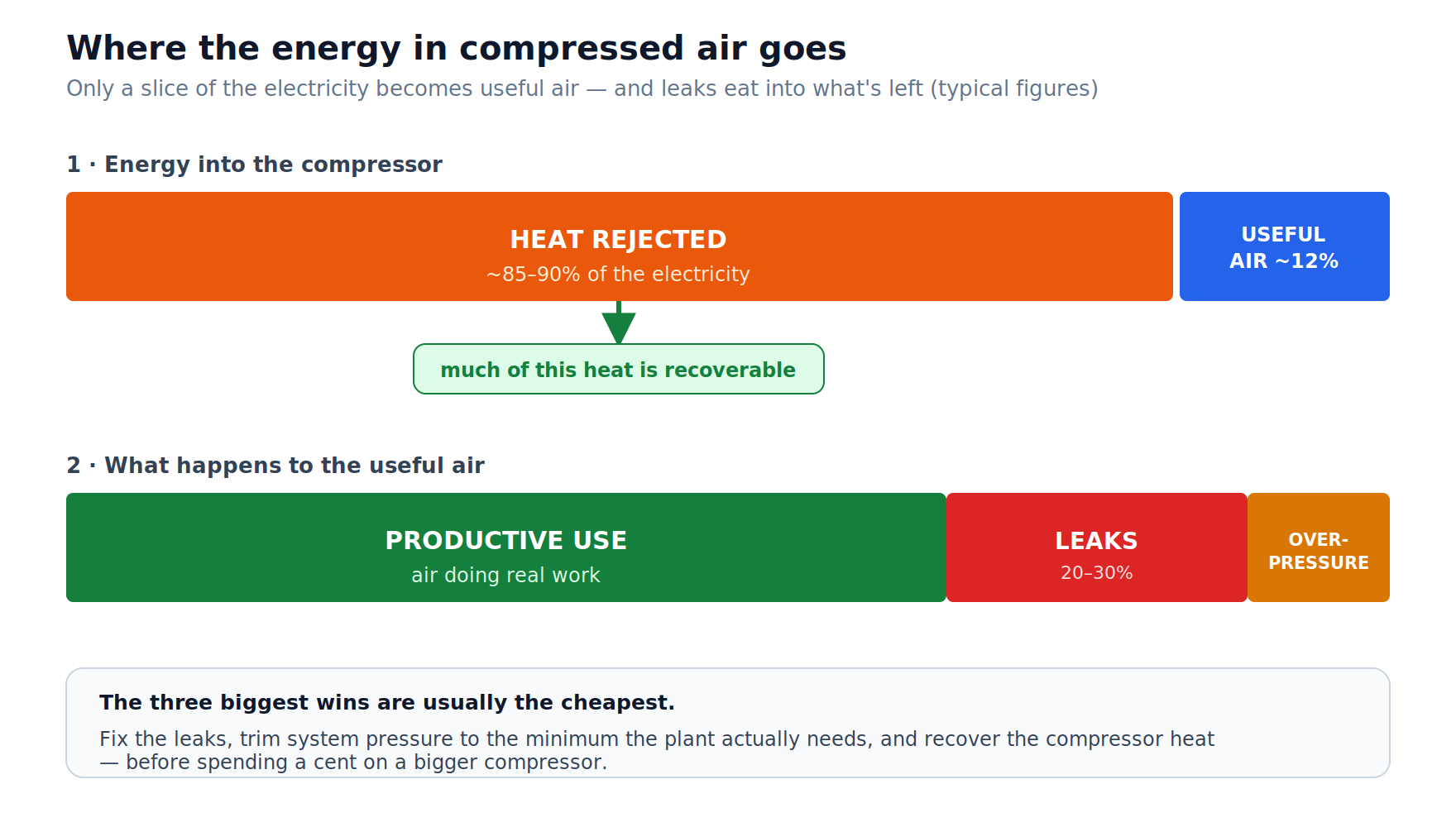
Where the energy in a compressed air system goes: most of the electricity becomes heat, and leaks and over-pressure eat into the useful air.
Where do industrial compressed air systems waste energy?
The losses are predictable, and most sites have several of them running at once:
- Leaks. The single biggest loss. In an unmanaged system, 20–30% of the air generated can leak away (an industry benchmark), and a leak runs 24 hours a day whether or not anything is being produced.
- Over-pressure and artificial demand. Running the whole system at a higher pressure than the highest genuine requirement wastes energy — as a rule of thumb, roughly every extra 1 bar adds about 7% to the compressor’s energy use — and it makes every leak worse.
- Inappropriate use. Using compressed air for jobs a fan, blower or brush would do far more cheaply — cooling, blow-off, drying, agitation — is expensive air doing a cheap job.
- Poor control and sequencing. Several compressors idling part-loaded, instead of one running fully loaded with the rest switched off, wastes energy on unloaded running.
- Undersized or poor storage. Too little receiver capacity causes pressure swings and short-cycling, which is hard on the compressor and the system.
- Wasted heat. The 85–90% of input energy that becomes heat is usually blown outside, when much of it could be recovered.
How to cut compressed air costs
The cheapest wins come first, and most don’t involve buying a bigger compressor:
- Find and fix the leaks. An ultrasonic leak survey locates them; tag, repair and then make it a routine, because leaks always come back.
- Lower the pressure. Trim system pressure to the minimum the plant genuinely needs — every bar counts.
- Stop inappropriate uses. Switch open blow-off and cooling duties to blowers or fans.
- Sequence and right-size the compressors. Match generation to real demand rather than running everything part-loaded.
- Fix the storage. Correctly sized receivers steady the system and stop short-cycling.
- Recover the heat. Capture compressor heat for space heating, water preheating or a process load — the same heat-recovery thinking that applies to steam.
- Meter it. You can’t sustain a saving you can’t see, so measure the system and keep watching it.
Start by measuring and surveying
The discipline is the same one that drives savings on the steam side: measure first, then act. An audit quantifies your air demand, your leak load and your pressure profile, and turns them into a ranked list of fixes with the payback attached — so effort goes where the money is.
Energy Specialties brings water and compressed air expertise alongside its steam work, and can scope the opportunity through a consultancy and system design review, specify the fixes and any heat recovery as engineered packages, and deliver them as a single turnkey project. Get in touch to find out what your compressed air is really costing you.
Frequently asked questions
What is an industrial compressed air system?
It's the network of compressors, storage receivers, dryers, filters and distribution pipework that generates compressed air centrally and supplies it to points of use across a plant. It's often called the “fourth utility” after electricity, gas and water.
Why is compressed air considered so expensive?
Because compressing air is inefficient — only about 10–15% of the electricity into a compressor ends up in the air, with the rest lost as heat — and because electricity is the dominant lifetime cost of running a compressor. Wasted air therefore wastes expensive power continuously.
How much compressed air is lost to leaks?
In systems that aren't actively managed, 20–30% of the air generated is commonly lost to leaks. Because leaks run continuously, even at nights and weekends, they're usually the largest single saving available.
What pressure should a compressed air system run at?
As low as the highest genuine point-of-use requirement allows. Running higher wastes energy — roughly 7% more per extra bar — and increases leakage, so trimming pressure to the real minimum is one of the simplest savings.
Can you recover heat from an air compressor?
Yes. Since most of a compressor's electrical input becomes heat, much of it can be recovered for space heating, water preheating or a process load, which is one of the highest-value opportunities in a compressed air system.