


Common Steam System Inefficiencies in Food Manufacturing
The most common steam inefficiencies in food manufacturing are condensate dumped to drain over contamination fears, live steam injected directly into hot water, vapour and flash steam vented from cookers and renderers, boilers sized for batch start-up peaks that cycle for the rest of the day, and uncontrolled wash-down and steriliser use. Each can be fixed without compromising hygiene.
Food plants are among the heaviest steam users in Australian industry, and in most of them hygiene rightly comes first. The problem is that hygiene rules often get applied in ways that waste energy without making the product any safer. Improving manufacturing energy efficiency in a food plant is mostly about separating the two: keeping every hygiene control in place while stopping the energy losses that have grown up around them.
Why are food plants so steam-intensive?
A typical food plant uses steam for cooking and rendering, pasteurising and retorting, heating large volumes of hot water, and cleaning. Much of the demand arrives in batches tied to shift patterns, and cleaning between runs adds sharp peaks of hot-water use. The diagram shows the four usual steam users and where each tends to waste energy.
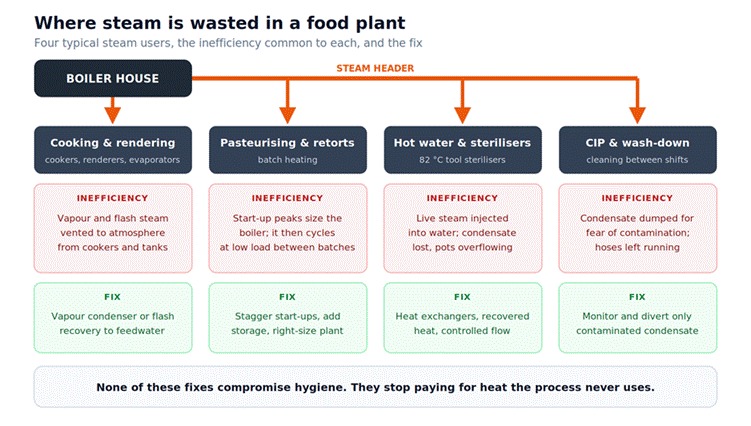
Where steam is wasted in a food plant: four typical users, the common inefficiency at each, and the fix.
Why do food plants send condensate to drain?
Because of contamination risk. If a heat exchanger leaks, product can get into the condensate, and nobody wants that returned to the boiler. The common response is to dump all process condensate, all the time.
That throws away hot, already-treated water that would otherwise cut fuel, make-up water and chemical costs. The better approach is to fit conductivity or turbidity monitoring on the condensate return, so the plant automatically diverts condensate to drain only when a problem is detected. The clean majority goes back to the feed tank. We cover the savings in how condensate recovery improves steam efficiency and the pipework side in condensate return systems.
Is direct steam injection wasteful?
Often, yes. Many food plants heat water by injecting live steam straight into it, whether in tanks, hot-water sets or the steriliser pots used for knives and tools. It heats quickly, but every kilogram of steam injected is condensate the boiler never gets back, so make-up water, water treatment and fuel all rise. Injection is also noisy and hard to control.
Some processes genuinely need direct injection, usually with culinary-grade steam, and there it stays. For general hot water, an indirect heat exchanger package heats the water while keeping the condensate clean and recoverable. Correct sizing matters: see how to size a steam heat exchanger correctly.
How much energy do cookers and renderers vent?
A lot, and it’s usually visible. Cookers, renderers, evaporators and flash tanks release vapour and flash steam that is often vented straight to atmosphere. That plume is energy the plant paid to create.
Energy Specialties’ project at Teys’ Wagga Wagga rendering plant shows what’s recoverable. A bespoke flash steam recovery skid now preheats 16,000 L/hr of boiler feedwater from 98 °C to 125 °C, and a vapour condenser captures the residual waste heat that was previously vented. Together they recover around 3.3 GJ per hour and have cut thermal energy per head processed by more than 30%. See our case studies and heat recovery systems for more.
Why do batch processes make boilers inefficient?
Batch cooking, pasteurising and retorting create short, sharp steam peaks, especially when several lines start up at once. Boilers get sized for those peaks, then spend most of the shift at low load, firing and stopping repeatedly. Each cycle wastes heat through purging and warm-up, and the boiler rarely runs at its most efficient output.
The fixes are operational as much as mechanical:
• Stagger start-ups so lines don’t all demand full steam at once.
• Add storage such as hot-water buffer tanks to absorb peaks.
• Sequence and right-size boilers to match real demand, including weekend and clean-down periods.
• Shut off lines to areas that aren’t running between shifts.
These are part of a wider set of losses covered in what causes steam energy losses in industrial plants.
What about wash-down, sterilisers and hot water?
Cleaning is where energy discipline tends to slip. Wash-down hoses are left running, hot water is generated hotter than the task needs and then cooled with cold water, and steriliser pots overflow continuously to keep water at temperature. Meat plants run hand-tool sterilisers at 82 °C, which is a hygiene requirement, but the way that temperature is held can waste far more heat than necessary.
Practical fixes include trigger-operated hoses, a hot-water system set to the temperatures each task actually needs, controlled flow to sterilisers, and preheating water with recovered heat. Refrigeration plant is a good source: food plants reject large amounts of heat from their refrigeration systems, and some of it can be recovered to preheat water before steam tops it up.
Where should a food plant start?
Start with measurement. Metering steam and hot water by area shows which of these inefficiencies are large on your site and which are minor. Without it, projects get chosen by opinion. See why you can’t save what you can’t measure.
From there, the typical order is condensate return with contamination monitoring, vapour and flash steam recovery, replacing direct injection where it isn’t required, then batch scheduling and boiler sequencing. Food and protein processors that have followed this path have seen strong results: one meat processor cut gas usage by 40% after its upgrades, and Fletcher International has saved several million dollars, with most projects returning their investment in under 12 months.
Energy Specialties provides steam and water metering and a consultancy and system design review to find and rank the opportunities, and can deliver the fixes as standard and bespoke packages through a single turnkey project. Get in touch to find out where your plant’s steam is going.
Frequently asked questions
What uses the most steam in a food processing plant?
It varies by product, but cooking and rendering, pasteurising and retorting, and hot water for cleaning and sterilising usually account for most of the steam in a food plant. Sub-metering each area is the only reliable way to know the split on a given site.
Can condensate be returned safely in a food plant?
Yes. Condensate from indirect heating is normally clean. Fitting conductivity or turbidity monitoring on the return lets the plant divert condensate automatically only if a leak contaminates it, so the clean majority can go back to the boiler feed tank.
Is direct steam injection inefficient?
Direct steam injection heats quickly, but every kilogram of steam injected is lost as condensate, so the boiler needs more make-up water, chemicals and fuel. Where the product or process doesn't require it, heating through a heat exchanger and returning the condensate is usually more efficient.
How can food manufacturers improve energy efficiency?
Start by metering steam and hot water by area. Then return clean condensate, recover vapour and flash steam, replace direct injection with heat exchangers where possible, control wash-down and steriliser flows, and match boiler capacity and sequencing to real batch demand.
What is manufacturing energy efficiency?
Manufacturing energy efficiency means producing the same output with less energy, by cutting waste in utilities such as steam, hot water, compressed air and refrigeration, recovering heat that would otherwise be lost, and matching plant operation to real demand.