


What Causes Steam Energy Losses in Industrial Plants?
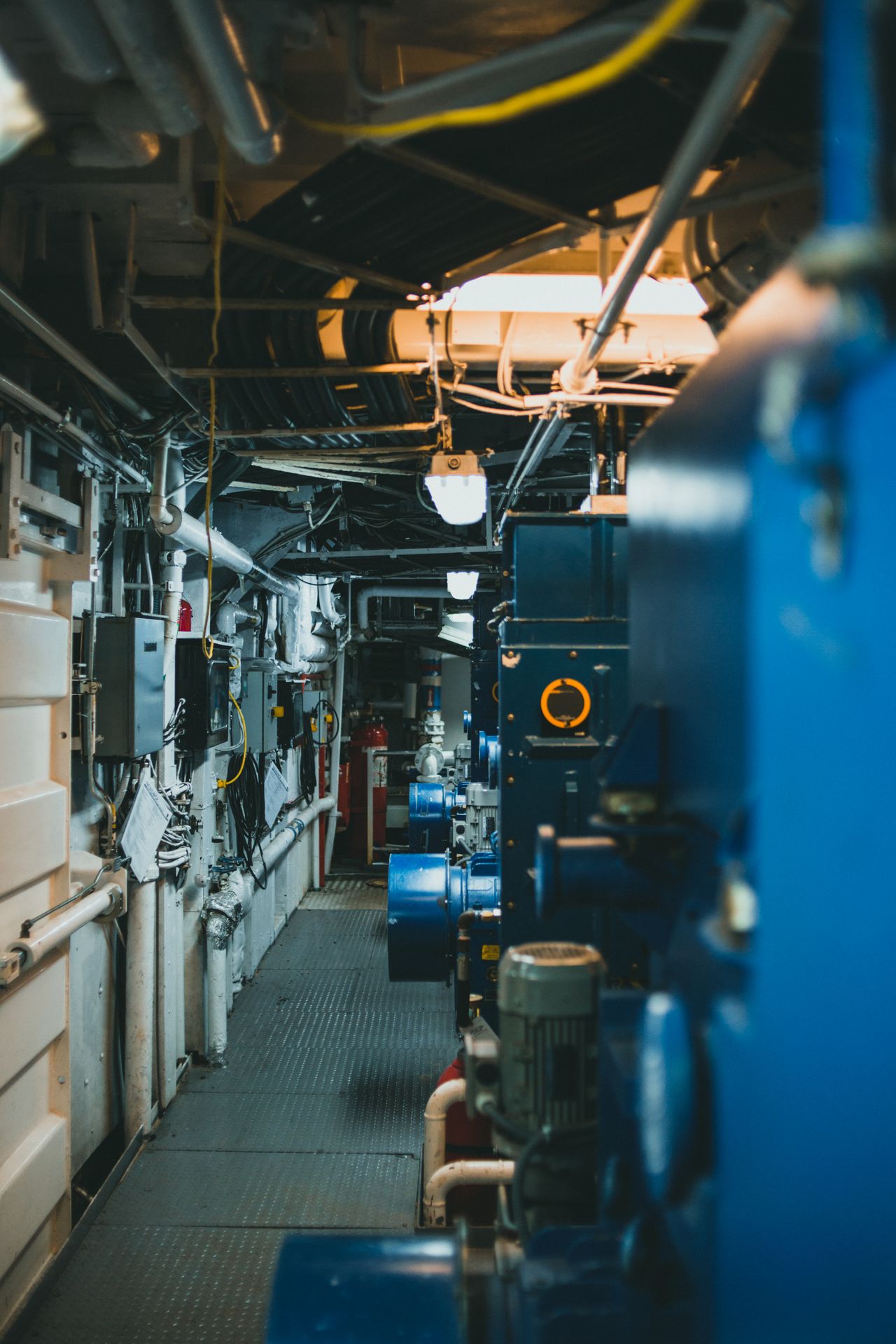
Steam energy losses in industrial plants come from three places: the boiler house (flue gas, scale, blowdown and standby running), the distribution system (bare pipework, leaks and failed steam traps) and the point of use (condensate sent to drain, vented flash steam and excess pressure). Most are continuous, hard to see and cheap to fix compared with what they cost.
That’s why the most effective industrial energy solutions rarely start with new plant. They start with finding where the steam you have already paid for is going to waste. This article maps every major loss in a steam system, explains the ones that are easy to overlook, and shows how to decide which to fix first.
Where does the energy in a steam system go?
Every loss in a steam plant sits at one of three stages. The boiler turns gas into steam, the distribution system carries it to where it’s needed, and the process uses it and sends condensate back. Energy escapes at each step.
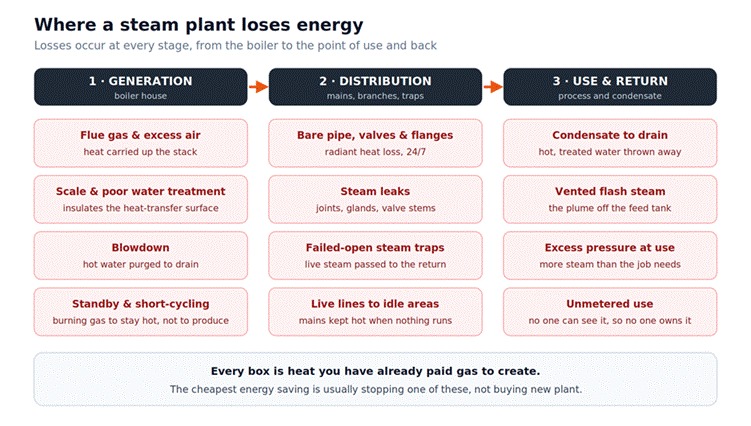
Where a steam plant loses energy: losses at generation, distribution and point of use.
The common thread is that every one of these is heat you have already bought. Nothing in the diagram improves the product; it all shows up on the gas bill. Some of these losses have their own dedicated articles on this site, linked below. The ones that don’t are covered in more detail here.
What are the biggest losses in the boiler house?
Flue gas and excess air. The hot exhaust leaving the stack is the largest single loss in most steam systems. Burners drift out of tune over time, and too much excess air means heating air that does nothing but carry heat out of the flue. As an industry rule of thumb, every 20 °C rise in flue gas temperature costs about 1% of boiler efficiency. A combustion check and burner tune is one of the cheapest fixes in the plant, and an economiser can then recover the heat that remains.
Scale and poor water treatment. Scale on the waterside of a boiler acts as insulation. Heat that should pass into the water goes up the stack instead, so flue temperature and fuel use both rise. Good water treatment matters, and so does returning clean condensate, which is already treated and far lower in dissolved solids than fresh make-up water.
Blowdown. Blowdown is necessary to control dissolved solids, but every litre leaves at boiler temperature. Blowing down more than the water chemistry requires wastes heat, and unrecovered blowdown sends that heat straight to drain.
Standby and short-cycling. Boilers held hot on standby, or oversized boilers that fire and stop repeatedly, burn gas without producing useful steam. Each restart typically begins with a purge that pushes cold air through the hot boiler and out of the stack. Matching boiler capacity and sequencing to the real load cuts this loss.
How much heat do bare pipes and fittings lose?
More than most people expect, and continuously. A bare steam main radiates heat 24 hours a day, whether or not the plant is producing. As a rule of thumb, correctly fitted insulation cuts that loss by around 90%.
The usual culprits aren’t long runs of bare pipe. They’re the fittings: valve bodies, flanges, strainers and pressure reducing stations where insulation was removed for maintenance and never replaced. An uninsulated valve can lose as much heat as a metre or more of bare pipe. Removable insulation jackets solve this, because they go back on after the next service. Damaged or water-soaked insulation also performs poorly and should be replaced.
Live lines to idle areas are a related loss. Mains kept hot to parts of the plant that aren’t running, or dead legs that are no longer needed, lose heat and form condensate for no benefit. Isolating them outside production hours is a simple fix.
What about leaks and steam traps?
Steam leaks from joints, glands and valve stems are easy to ignore because each one looks small. As an industry benchmark, a 3 mm hole at 7 bar g passes roughly 10 to 15 kg of steam an hour, every hour of the year. A walk-round with a tag-and-repair list is one of the fastest paybacks available.
Failed steam traps are the other major distribution loss. A trap that has failed open passes live steam straight to the condensate return, and in plants without a trap-management program, a significant share of traps are usually failed at any given time. We cover this in detail in how failed traps quietly waste fuel, and trap selection sits within steam, condensate and water valving.
Where is energy lost at the point of use?
• Condensate to drain. Hot, treated water thrown away means paying again for fuel, water and chemicals. See how condensate recovery improves steam efficiency.
• Vented flash steam. The plume off a feed tank or vent is live energy leaving the building, and it can be recovered with a heat recovery system.
• Excess pressure. Running equipment at higher pressure than the process needs increases losses and makes leaks worse. See steam pressure reduction.
• Wet steam and poor distribution. Wet steam carries less usable heat and damages equipment. See optimum steam distribution.
How do you work out which losses matter most on your site?
Every plant has most of these losses to some degree. What differs is their size, and that’s the only thing that should decide what gets fixed first. The practical sequence is:
• Measure. Steam and gas metering shows total consumption and where it goes. You can’t rank losses you can’t see; see why you can’t save what you can’t measure.
• Survey. Walk the system: leaks, traps, bare fittings, vents and drains, each costed.
• Fix continuous losses first. Leaks, failed traps, bare fittings and live lines to idle areas are cheap to fix and never stop costing.
• Then recover heat. Condensate return, flash steam and blowdown recovery, and economisers typically follow once the losses are under control.
• Keep measuring. Losses come back. Metering holds the saving in place.
Done in that order, the results can be substantial. Energy Specialties’ work with Australian meat processors has delivered a 40% reduction in gas usage at one site and a return on investment inside 12 months on most projects at another, and a flash steam recovery project at Teys’ Wagga Wagga plant cut thermal energy per head processed by more than 30%. You can read about these in our case studies.
Where to start
If your gas bill has crept up and nobody can say why, the answer is almost always in the list above. A site appraisal backed by steam and water metering finds the losses and ranks them by what they cost. From there, a consultancy and system design review sets out the fixes in order of payback, which can be delivered as engineered packages and a single turnkey project.
Get in touch with Energy Specialties to find out where your plant is losing energy, and what it would take to stop it.
Frequently asked questions
What is the biggest cause of energy loss in a steam system?
Flue gas leaving the boiler is usually the largest single loss, but it is rarely the most controllable one. The losses most plants can cut fastest are in distribution and end use: steam leaks, failed-open steam traps, bare pipework and condensate sent to drain. Metering shows which is largest on a given site.
How much heat does uninsulated steam pipe lose?
Bare steam pipe loses heat continuously, whether or not the plant is producing. As a rule of thumb, correctly fitted insulation cuts that loss by around 90%, and an uninsulated valve or flange can lose as much heat as a metre or more of bare pipe.
How can I reduce steam energy losses in my plant?
Measure first, then fix the continuous losses: repair leaks and failed traps, insulate bare pipe and fittings, isolate lines to idle areas, return condensate, recover flash steam and blowdown heat, tune boiler combustion and run steam at the lowest pressure the process needs.
What efficiency should an industrial steam boiler achieve?
A well-maintained modern gas-fired steam boiler typically runs in the low-to-mid 80s percent on a gross basis, and higher with an economiser. Poor combustion tuning, high excess air, scale and frequent cycling all pull it down.
What are industrial energy solutions?
Industrial energy solutions are the measures and services that reduce energy use in industrial plants, such as energy auditing, metering, heat recovery, system redesign, controls and equipment upgrades. For steam users, the best returns usually come from finding and stopping existing losses.