


Process Heating Systems: Steam, Hot Water or Thermal Oil?
For most industrial process heating systems, the choice of heating medium comes down to temperature. Hot water suits loads below about 95 °C, steam is the workhorse from roughly 100 °C to 200 °C, and thermal oil takes over above that, reaching around 300–350 °C at near-atmospheric pressure. Load profile, heat-transfer rate and running cost then decide between the close calls.
Getting that choice right matters, because the heating medium sets the plant’s efficiency, capital cost and maintenance burden for decades. This article compares the three, explains where each fits, and sets out how to decide.
What is a process heating system?
A process heating system generates heat centrally and carries it to the equipment that needs it: cookers, dryers, reactors, tanks, pasteurisers, presses or wash systems. The heat is carried by a fluid, and that fluid is the key design decision. It determines the temperatures the plant can reach, the pressures it must contain, how fast heat moves into the product, and how much energy is lost along the way. In short, it shapes the whole of the plant’s thermal energy systems.
How do steam, hot water and thermal oil compare?
The chart shows the typical working range of each medium, and how much heat a kilogram of each delivers.
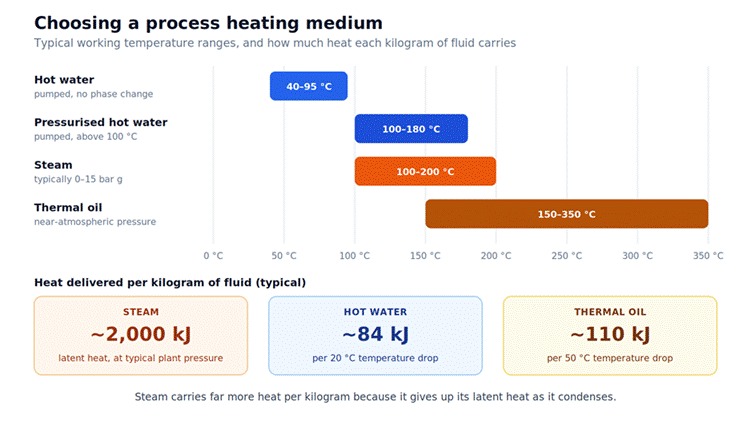
Typical temperature ranges for process heating media, and the heat delivered per kilogram of each.
The headline difference is latent heat. A kilogram of steam gives up about 2,000 kJ as it condenses. A kilogram of hot water cooling by 20 °C gives up about 84 kJ, and thermal oil cooling by 50 °C about 110 kJ. That’s why steam moves large amounts of heat through small pipes and compact heat exchangers, while water and oil need pumps and much higher flow rates.
When is steam the right choice?
Steam is the default for good reason. It condenses at a fixed temperature for a given pressure, so heating surfaces stay at an even temperature and control is as simple as controlling pressure. Condensing heat transfer is fast, which suits processes that need rapid heat-up or high heat flux. Steam flows to the point of use under its own pressure without pumps, and one boiler plant can serve many different loads at different pressures through pressure reducing stations.
The trade-off is that steam systems need looking after. Condensate has to be removed and returned, traps maintained, water treated, and distribution kept dry and well insulated. When that discipline slips, losses mount quickly, as our posts on steam trap systems, condensate recovery and steam distribution explain. Well-managed steam is highly efficient. Neglected steam is not.
When is hot water a better fit?
For loads below about 95 °C, such as washing, CIP, preheating, space heating and many food processes, hot water is often simpler and cheaper to run. There are no steam traps and no condensate return, distribution losses are lower because pipe temperatures are lower, and the system is easier to operate. Pressurised hot water extends the range to about 180 °C for plants that want water-side simplicity at higher temperatures.
The penalties are pumping energy and bigger pipework, because each kilogram of water carries far less heat than steam, plus a temperature that drops as heat is given up. Many plants get the best of both by keeping steam as the main distribution medium and making hot water locally, close to the load, with a steam-to-water heat exchanger package. Sizing those units correctly is covered in how to size a steam heat exchanger correctly.
When does thermal oil make sense?
Thermal oil comes into its own above about 200 °C. To reach 250 °C with saturated steam, a system would need roughly 40 bar, with all the cost and compliance that brings. Thermal oil reaches the same temperature at close to atmospheric pressure, which makes it common in frying, baking, chemical reactors, presses and other high-temperature processes.
It has drawbacks. Oil transfers heat less readily than condensing steam, so heat exchange surfaces are larger. It must be pumped, it degrades with time and temperature and needs periodic testing and replacement, and a leak creates a fire risk that steam and water systems don’t have. It’s the right answer for high temperatures, but rarely the right answer below them.
How do you choose the right process heating system?
The right medium falls out of a few questions about the process and the plant:
• What temperature does the process actually need? This is the first filter, and the most commonly over-specified. Designing for the real requirement often opens up simpler, cheaper options.
• How does the load behave? Fast heat-up, batch peaks and tight control favour steam. Steady, low-temperature loads favour hot water.
• What does the plant already have? Existing boilers, distribution and condensate return usually make extending steam, or adding local hot-water generation, the most economical path.
• What will it cost to run? Fuel, pumping, water treatment, fluid replacement, maintenance and distribution losses all count, not just the capital cost.
• What is the plant’s energy future? Lower-temperature hot-water loads are easier to supply from recovered heat, or from heat pumps and electrification later, which is a good reason not to run everything hotter than it needs to be.
Can a plant use more than one?
Yes, and most well-designed plants do. A typical arrangement is central steam for high-temperature and fast-response loads, local hot water generated by heat exchangers for washing and low-temperature processes, and heat recovery feeding recovered energy back into feedwater or hot-water systems. The aim is to match each load to the lowest-temperature, lowest-loss medium that does the job. Food processors face this choice constantly, as covered in common steam system inefficiencies in food manufacturing.
Where to start
If you’re planning a new line, an expansion or a replacement boiler, the heating medium is worth deciding deliberately rather than by habit. Start by measuring what your processes really use with steam and water metering, then test the options through a consultancy and system design review. Energy Specialties designs and supplies standard and bespoke packages for steam and hot-water systems, and can deliver them as a single turnkey project. See our case studies for examples, or get in touch to talk through your process heating.
Frequently asked questions
What are the main types of process heating systems?
The three most common heat-transfer media in industrial process heating are steam, hot water (including pressurised hot water above 100 °C) and thermal oil. Direct-fired and electric heating are also used for some processes, but most plants distribute heat using one or more of these three fluids.
Is steam or hot water better for process heating?
It depends on temperature and load. Hot water is usually simpler and more efficient to distribute for loads below about 95 °C. Steam suits higher temperatures, fast heat-up and precise temperature control, because it condenses at a fixed temperature for a given pressure and transfers heat at a very high rate.
What temperature can thermal oil reach?
Thermal oil systems typically operate from around 150 °C up to about 300–350 °C, depending on the fluid. Their main advantage is reaching those temperatures at close to atmospheric pressure, where steam would need very high pressures.
Why does steam transfer heat so well?
Steam gives up its latent heat as it condenses — roughly 2,000 kJ per kilogram at typical plant pressures — and condensing heat transfer coefficients are very high. That lets steam deliver a lot of heat through compact heat exchangers at an even, controllable temperature.
What are thermal energy systems?
Thermal energy systems generate, distribute and use heat in a plant: boilers or heaters, the steam, hot water or thermal oil that carries the heat, the pipework and heat exchangers, and the controls and heat recovery equipment that tie them together.